ARCHIVE: What it's like to write code at Meta

ARCHIVE: What it's like to write code at Meta

Meta Tech Podcast

B1September 1, 202548 min
Play

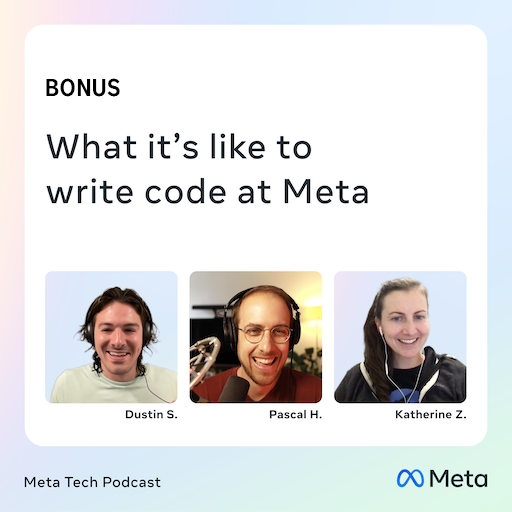
To not leave you without an episode for August, Pascal brings you an episode from the Archive. Back in August 2023 for Episode 55, Pascal spoke with Katherine and returning guest Dustin, two software engineers at Meta about how to ship code at Meta. Why do we have a monorepo? Why and how do we do pre-commit code review? What does our CI infrastructure look like? Get the answers to these questions and many more in this episode of the Meta Tech Podcast. Got feedback? Send it to us on Threads (https://threads.net/@metatechpod), Instagram (https://instagram.com...

Transcript

Automatically generated from the audio. May contain errors.

Hello and welcome to a bonus episode of the MetaTek Podcast, a podcast by Meta where we talk to engineers working on different technologies. My name is Pascal and only for this second time in nearly seven and a half years of making this podcast, I'm reaching into the archives. Why? Well, and I'm sure some of my fellow software engineers will

sympathise, I'm hopeless with dates. Metaconect is just around the corner, September 17th and 18th, that's 2025 for those of you from the future. It's thrilling news for developers, creators, AI buffs and M.R. fans alike, but if you're me and you need someone to review your freshly recorded interview, you'll find yourself politely shuffled to the back of the queue.

So rather than an episode on training models to generate 3D assets and weaving them into our products, I'm dusting off a classic from August 2023 that's truly stood the test of time. I sat down with Catherine and Dustin, two names almost everyone at Meta knows by their internal handles Dustin's act. We dive into what it's really like to write and ship code here. While

many companies slow down as they grow, not just from process or red tape, but the sheer weight of more code, tests, static analyzers and source control groaning under tens of millions of files, Meta's Mufast Mantra is still very much in life. In this chat, we explore some of the infrastructure that keeps us nimble.

But enough of me rambling into my travel mic, which is currently hogging precious space on my 3300km interrail trip, just so you don't miss an episode in August. Let's hop into the time machine for my conversation with Dustin and Catherine. Today, we are going to have a discussion that I've been wanting to have for years.

We will be chatting about what it's actually like to write code at a company of this size and the unique culture at Meta that allows us to move fast despite tens of thousands of engineers and many million lines of code. And I'm excited to have two long-term Facebookers and now Metamates with me to discuss

all that. Catherine and Dustin, welcome and actually welcome back to the Meta Tech podcast. Thanks. Thanks for having me.

Amazing. Catherine, can we start with you? Because you're new here on the podcast. How long have you been at Meta and what did you do before?

I've been at Meta for a little over 11 years now. I guess it's coming up on 11 and a half. Prior to that, I was actually working at a thin film solar cell manufacturing company, like literally the solar panels that would go onto your roof.

I majored in chemical engineering in college and did the pivot actually on the job. I learned how to code once I got here. That is so exciting for multiple reasons. So not only because I feel like Soiler is actually one of the appropriately

hyped technologies in the sense that they might actually have a shot at giving us a chance of blunting the blow that the climate crisis is having on us. And then obviously the second part that you did not know how to cope before you got here.

So how was the interview process like for you? And how was it learning on the job? I did a lot of data analysis for the ThinVolm Solar Solmere manufacturing company. So the interview was actually for a data analyst position.

It was, here's two tables. How do you do a left join? What does a right join mean? So I got the job as a data analyst.

But when I got here, I realized like the, there was just so much more power encoding. I wasn't really that good at the analysis. Truthfully, what I really enjoyed more was figuring out how to program, how to automate the analysis so that the query would run daily using our internal framework

for ETL extract, transform, and load. And so kind of from there, I just leveraged all the internal resources that we had leaned on other engineers to help me and then went through our bootcamp process about a year after I joined and transitioned to be a software engineer.

That is such a cool journey. We've had an entire reposite about internal mobility before, and I had no idea that you were also one of the prime examples of how far you can go, because I said this before. We set up this interview here that you are one of those people that everybody working

at Meta in certain parts at least will at some point cross paths with, because you are all over diffs that touch anything code review related or tasks, and you can submit it in within two seconds. We all have like a Catherine comment on them.

So it's really amazing. But OK, before we actually get into that whole topic, Dustin, let me pass this on to you. So how long have you been now at Metta?

And which space do you work in? I have been at Metta for coming up on nine years. And I work in the mobile space. professionally, I've always been a software engineer.

My story is not nearly as cool. I did go to college thinking I'd be a music performance major. That's where I started, search and computer science.

I will say I do have an interesting internal mobility story too. I joined the company knowing Java. I previously worked at Orbitz and it's a travel company. And I came in looking for a server job and everything here is well known to be written in hack.

So I was doing bootcamp tasks in hack with a very well known engineer here named Zef. And Zef gave me a task. And during bootcamp I caused a SEV. And the SEV was around life events.

you know, when you post, you're like, graduated college, had a child. Everyone's life event on Facebook.com was graduated from Stanford University, January one 2004. So they filed a SEV and I was still in bootcamp and I was, I was terrified.

And the thing that gave me a lot of comfort was that there was no blame. They, pretty funny, you know, they got it reverted pretty quickly, but I immediately started looking for other teams and I met with a manager who worked in mobile, which I had very, very little experience in.

And I was like, I got to get out of server. Like I'm there. And he was like, that's totally fine. He's like, we're looking for someone to kind of like ramp up

on this mobile app called Paper.

This is the opening of the episode. Open the player for the full interactive transcript with clickable words, translation and flashcards.

Open full transcript

Audio belongs to its publisher and is played from their feed. Rights holders can request removal — copyright & takedown policy

Episodes · Meta Tech Podcast