What Happens When You Build a Water Membranes Factory Just to Prove a Point?

What Happens When You Build a Water Membranes Factory Just to Prove a Point?

(don't) Waste Water! | Water Tech to Solve the World

B2November 20, 202528 min
Play

How Is Aqua Membranes Scaling 3D-Printed Water Membranes Spacers from Garage Startup to 200,000 Square Foot Manufacturing Facility? Let's find out! 🤫 Tired of stitching together Crunchbase, overpriced reports, and "a guy who knows a guy"? I built the fix. 50 Founder Seats. Join the waitlist: leviathandata.io 🙌 Supporters 🙌 A big thank you to my partner SimpleLab: https://link.dww.show/simplelab ⬇️ IN THIS VIDEO ⬇️ Aqua Membranes manufactures reverse osmosis membrane elements with 3D-printed spacers that reduce energy consumption and pressure drops in industrial water treatment across mining, se...


Transcript

Automatically generated from the audio. May contain errors.

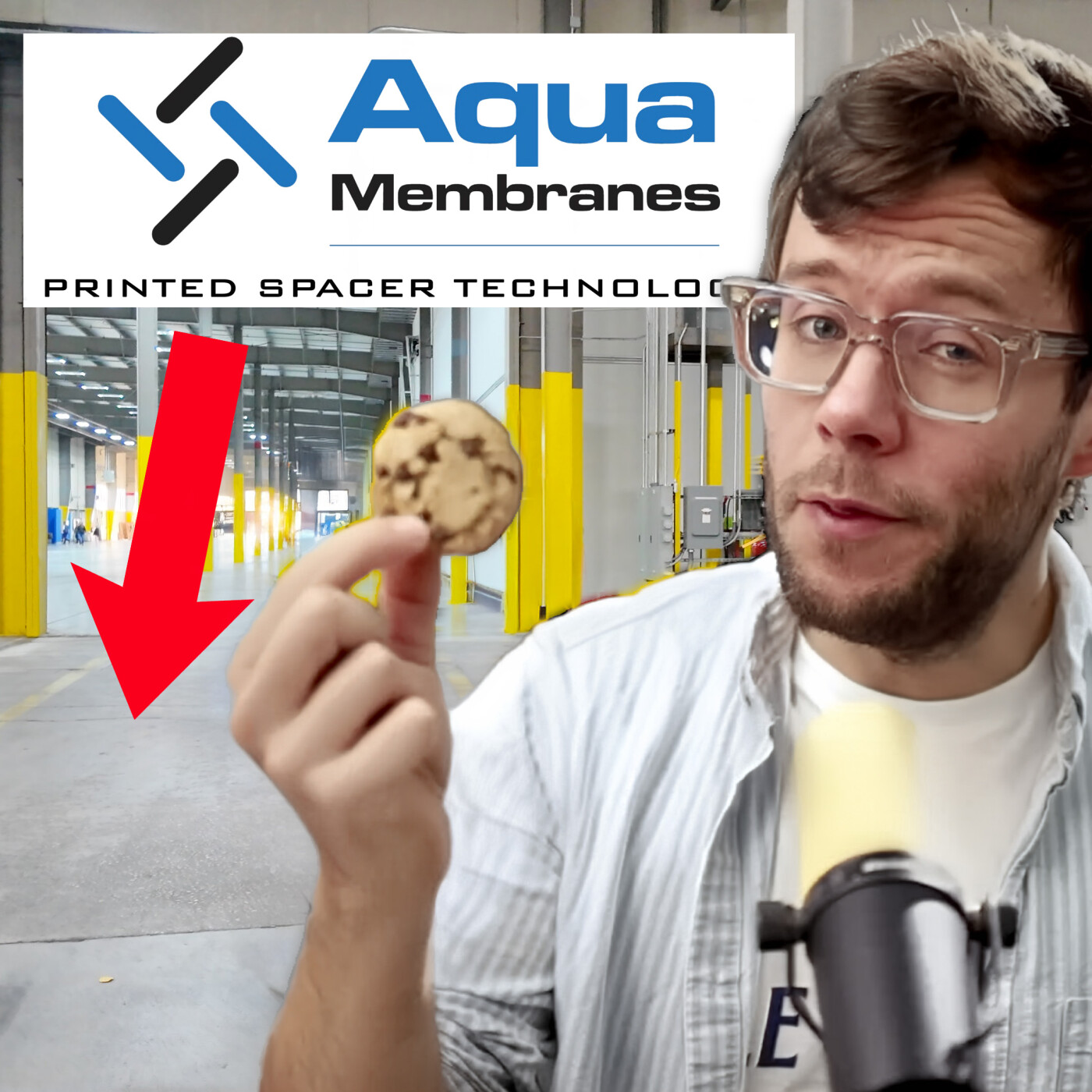
This is a cookie and even if you listen to this and don't see it, you know exactly what it looks like it's round, it's crispy and it features delicious looking chocolate chips. But let's imagine for a split second that I have a means to drastically improve this cookie by replacing the sugar inside with my newly invented sugarium, a substance that has the same sweetening power as sugar,

but cuts calories in half and brings a good bunch of vitamins for each bite of that delicious cookie. If you were a cookie manufacturer, would you believe me on the spec sheets and buy it blindly? Well, I doubt it, right? No, you'd probably expect me to put it in a cookie so that you can taste it and then you also want me to put that cookie next to a regular cookie and to blind taste it.

Then also give it to a panel so that they can provide you feedback on the cookie's taste, shape or even smell. Then you like to check if it changes your cookie production process and if it alters or expands the cookie's shelf life and if you can source Sugarium from only me or if you have purchasing power because someone else may produce it as well and so on and so on

Is this fair to me? Come on. I'm a chemist and I just invented sugarium an absolutely superb molecule Why do I have to go through all of this? Well, watch, learn and donate my cookie because when you want to replace an incumbent that's universally accepted on the market, you have to show not to tell that you're better and you need to demonstrate your pitch in real life. Fair or not, it's a process, either you're

ready for it or everyone will keep eating sugar. Now, I don't know if sugarium exists or will ever be invented, but what I know is that there is a direct equivalent to that metaphor in water tech with membrane materials. Indeed, through the years running this podcast, I've been lucky to encounter many great step changes to membrane technologies, but they

all have that one thing in common, whether they like it or not, they had to go through the sugary steps. Namely, some brilliant chemist or inventor would come up with a new membrane material, like for instance these ceramic elements I got from Sembrain and would hope for it

to get adopted by membrane manufacturers only to realize that nobody is going to take a membrane material or element at face value. You'll have to build a module at least and most probably a full membrane system, then get it tested in pilots, then in full scales and in the real world, for everyone to accept

that indeed, your new material or element is valuable. So even if what you want to do is market or even license a material formula or an element's design, you will have to go up the value chain at least temporarily and produce up to the final skid or at least commercial scale modules to be taken seriously.

And you may have to do that at scale and for a while because it's one thing to get adopted somewhere, it's something else to become so much of the new standard that your technology gets a sizable share of the market and is past the tipping point so that you can double down on what you wanted to do all along which is to produce sugarium and not fully

packaged cookies. This was true when John Caddott founded FilmTech in 1977 as a spin-out of the North Star Research Institute in Minnesota and produced the first spiral-wound polyamide reverse osmosis membrane that would become the standard in the early 90s.

This is still true today when a membrane, a zwitterko, a nala membrane, a swill-tex or an active membrane need to produce at least commercial modules, if not simply turnkey solutions to get their material science proven in the real world. This in itself is a major barrier to entry, but also a massive moat.

Once you've entered, ask for a film tech that got acquired by Doh in 1985 for $225 million once adjusted for inflation. You have several examples of companies like LeakTech, to name one, that are down 98% from their IPO valuation on the back of yours, struggling to get their silicon carbide

material accepted in nanofiltration and river sosmosis territories. I've said it before but this is a major reason why membranes, their materials and elements are the water tech that behaves the most like actual tech. High barrier to entry, tremendous capex needs but also the greatest potential for scale

once adopted. Now all of that is nice but it's theory, right? And you know the saying, show don't tell so let me show you this empty warehouse. This large open and as I said empty space is actually in Knoxville, Tennessee.

And from the day I recorded this on, it's also officially the place where Aquamembranes expects to produce and scale its membrane spacer business. All that space just for spacers? Well, not really, because like I said, Aquamembranes, at least for now, can't just market its

sugarium. It needs to produce cookies and they will. How? Why?

What's the plan? out, let's find out. The business model that we're focused on in large part is about demonstrating to the sort of the marketplace, the value that could be delivered with the elements.

Shipping printed leaves requires that somebody wants to buy printed leaves to use in their elements, which is something that we're interested in. But we're still kind of earlier than that where we're really trying to get the product in the field to get success stories kind of showing that you can reduce pressure drops

that you can reduce energy consumption, run longer periods of time, to create kind of a market demand to start pulling through the, hey, I'd love to have printed leaves. Our experience in coming both, especially in CJ's knowledge, but also my own, is that it would be difficult for a Toray or an LG Chem soon to be nano-H2O or a Nido Denco

to really fully adopt our technology unless it was really de-risked. So the best way to de-risk it is for us to prove it ourselves. So how do we prove it ourselves? Well, we make the modules And we sell the Coca-Cola, we sell to Micron, we sell to mining companies, we sell the OsmoFlow.

This is the opening of the episode. Open the player for the full interactive transcript with clickable words, translation and flashcards.

Open full transcript

Audio belongs to its publisher and is played from their feed. Rights holders can request removal — copyright & takedown policy

Episodes · (don't) Waste Water! | Water Tech to Solve the World