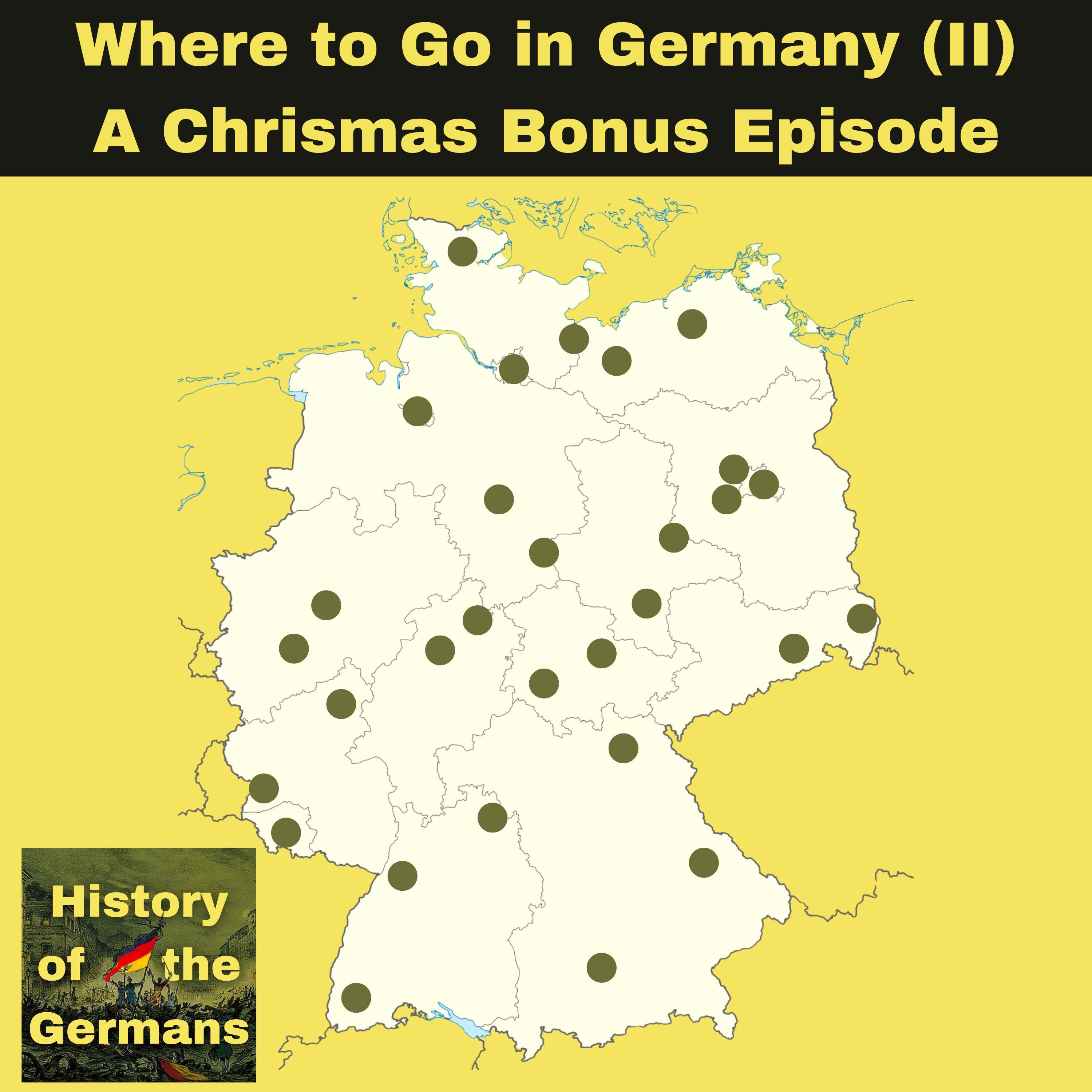
One of the legacies of the Holy roman empire is that Germany does not have just one place where everything happens, where politicians, entrepreneurs, bankers, artists, and actors travel on the same underground trains and eat at the same restaurants. Berlin is the capital with its political class of members of the Bundestag, journalists and lobbyist and at the same time a major gathering place for artists, musicians and thespians of all stripes and home to many tech startups. But the bankers are in Frankfurt, the headquarters of the major companies are in Stuttgart, Munich, Düsseldorf and spread a...
Transcript
Automatically generated from the audio. May contain errors.
Hello and welcome to the second part of your Christmas bonus, my entirely subjective list of places to visit in Germany. Today, we'll cover the remaining Bundesländer, namely Nordrhein-Westfalen, Rheinland-Pfalz, Saarland, Sachsen, Sachsen-Anhalt, Schleswig-Holstein, Thüringen and two more places that I have
chosen entirely because I can. Now one of the legacies of the Holy Roman Empire is that Germany does not have just one place where everything happens. Politicians, entrepreneurs, bankers, artists and actors travel on the same underground trains
and eat at the same restaurants. Berlin is the capital with its political class of members of the Bundestag, the journalists and lobbyists and at the same time a major gathering place for artists, musicians and thespians of all stripes and home to many tech startups.
The bankers are in Frankfurt. The headquarters of the major companies are in Stuttgart, Munich, Düsseldorf and Spedround everywhere. Several of the major publishing houses are in Hamburg, the private TV stations in Munich.
But none of these places have a monopoly on any of these activities. There are banks headquartered in Munich and major corporates in Frankfurt. There is great theatre in Düsseldorf, Dresden and Schwerin. There are world leading companies headquartered in tiny towns like Künzelsau.
that cuts right through to the major cultural sites. Though the quip that there were 365 states in the Holy Roman Empire is vastly exaggerated, there were once maybe about a hundred capital cities, from splendid Dresden to tiny Hohenzollern-Hechingen,
each with its princely residence, cathedral, grand monastery and theater. The great artists either traveled from court to court, leaving behind their works here or there, or stayed in one of the free imperial cities operating large workshops. Therefore, what you cannot do in Germany is to go to one city and see all the major treasures
the country has collected over the centuries, as you can do in the Louvre or the British Museum and the National Gallery. In Germany you have to move around, see one thing at a time, always in the knowledge that its significant counterpart may be a few hundred miles north, south, east or
west of you. This is one of the legacies of the medieval empire that Germany has in common with Italy. And hence we are going through each of the Bundesländer trying to pick out one absolute Must-See and one place where you are likely to encounter fewer people.
And as we have covered nine Bundesländer up to Mecklenburg-Vorpommern already, our next location we will have to get to is Nordrhein-Westfalen. Now, if we talk about Mastiz, Aachen is where every upstanding listener of the history of the Germans will go, and it is undoubtedly the right thing to do.
The Imperial Chapel, with its Roman columns brought across from Rome and Ravenna, and Barbarossa's magnificent chandelier, provides suitable surroundings for the coronation since Otto the Great. And if you happen to go there, take a look at the treasures in the Dom Museum, worth
absolutely every second of it. And do not forget to listen to the ghoulish opening of Charlemagne's grave by Otto III in episode 14 just before you go. A close second place you should not miss is Cologne. A city has been mentioned 500 times already in the show and there are likely another 500 incidences to come. Germany's most venerable
fallen for a long time, largest city has been the stage for events from the prologue episode to the Siege of Noise we discussed in episode 214. As the seat of one of the seven Prince-Electors, a major pilgrimage destination and the main hub in the trade between the Empire and England, Cologne often played a decisive role.
Its history is so varied and significant, it warrants its own podcast, The History of Cologne by Willem Fromm. the things to see in Cologne. The cathedral and its shrine of the three wise men is unavoidable. I would also recommend the Römisch-Germanische Museum that displays items related to the
long history of Roman presence in Germany and specifically in Cologne. And do not miss the remains of Cologne's history as a free and peal merchant city and senior member of the Hans-Jarthic League. As the Overshtolzenhaus from the 13th century and the town hall with its 16th century porch, there is the Gürzenich, or banqueting hall, of the merchants of the city which dates
from 1441 and the 16th century Arsenal. All are reconstructed on the outside, though the interior has sadly been lost to war damage. These alone would justify a visit, but one makes it a must see other 12 grade Romanesque churches, including St. Gerion, St. Severin, St Ursula, St Maria in Capitol, St Cuniber, St Pantaleon, St Apostle and St Martin.
Few cities in Europe can boast such a density of sacred architecture built between the 4th and 13th century. Once you have survived the marathon of Romanesque art, head down to Früß or Sønner im Valfisch or a seon for refreshing Kölsch and the unique atmosphere of a classic Cologne beerhouse.
And if you do that, you have to then take the S-Bahn down to Cologne's eternal rival, Düsseldorf and taste their Altbier in one of their traditional beerhouses, like the Füchchen, the Schiffchen or the Ürige. 18 million people spread over 34,000 square kilometers, making Nordrhein-Westfalen
in one of Europe's most densely populated areas, in particular the almost continuous urban landscape between Düsseldorf and Dortmund, otherwise known as the Ruhr. I would love to say that the Ruhr is pretty, but that would be pushing it. There are pretty places though, like the Breedeneil Lake and its park with the villa
of the Krupp family or the Schwebebahn in Wuppertal. And several of these cities are actually very old. As an abbey boasts an Atonian vestwerk and 10th century artworks. And Dortmund had been a member of the Hansen and still retained some vestiges of that time,
whilst Mercator famously established a cartography business in Duisburg. If people travel there from afar, it is very rarely for these cultural artefacts, but
This is the opening of the episode. Open the player for the full interactive transcript with clickable words, translation and flashcards.
Open full transcriptAudio belongs to its publisher and is played from their feed. Rights holders can request removal — copyright & takedown policy