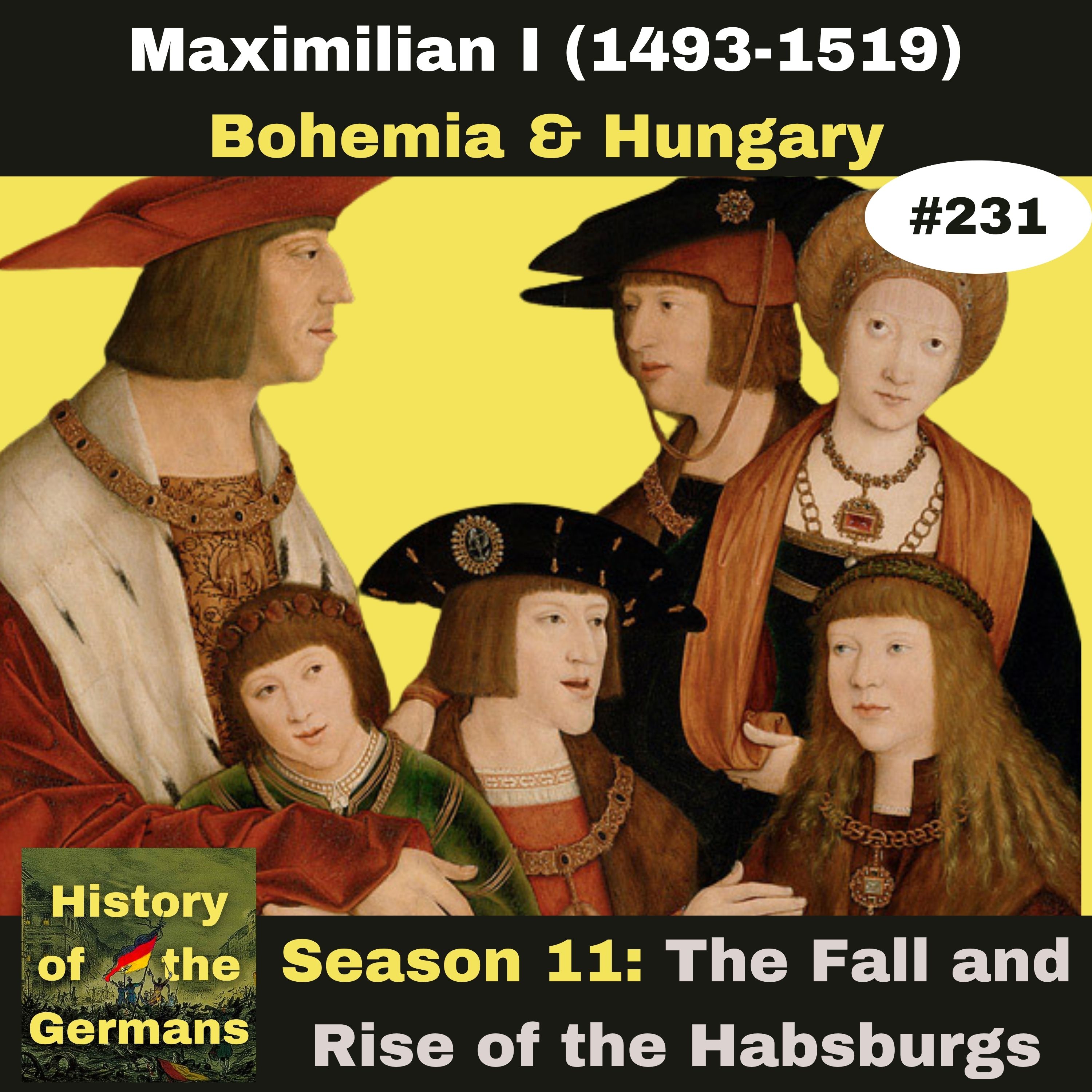
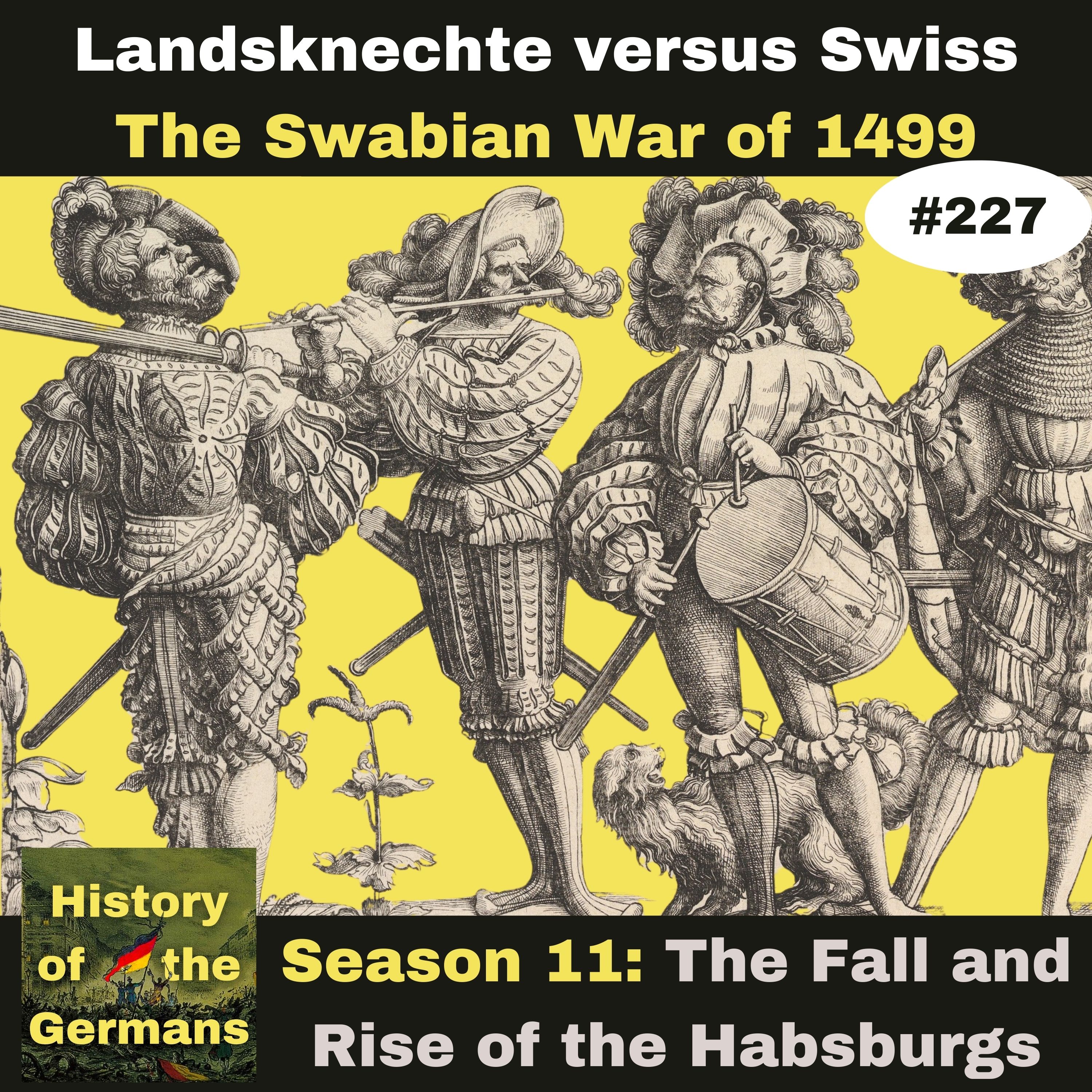
In this episode the 15-year long war over the Burgundian succession will come to its end. You may have thought it was done last time, but no. The revolutionary spirit of the Flemish cities is not yet broken and their most audacious move is still to come. And this time they are not going up against an archduke and regent, but against a newly elected king of the Romans. Maximilian of Habsburg’s experience in Burgundy swung between moments of utter delight and happiness and depths of death, destruction and despair. It shaped this young duke who ar...
Transcript
Automatically generated from the audio. May contain errors.
Hello and welcome to the history of the Germans, episode 220 The Burgundian Experience. In this episode, the 15 year long war over the Burgundian succession will come to its end. You may have thought that was done last time, but no. The revolutionary spirit of the Flemish cities is not yet broken and their most audacious move is still to come.
this time, they are not going up against an archduke and a regent, but against a newly elected king of the Romans. Maximilian of Habsburg's experience in Burgundy swung between moments of utter delight and happiness and the depths of death, destruction and despair. It shaped this young duke who arrived aged 18 full of dreams of chivalry
and left age 31, a battle-hardened general with a clear view of where he wanted to take the empire. Get ready for the ultimate roller coaster. But before we start just a quick update on the history of the German's tour, I must say I was completely overwhelmed by the response. Effectively we were overbooked within 24 hours.
That left me on the one hand elated that so many of you want to come along but also with the unpleasant task of having to prioritize. As I mentioned before, we were giving patrons priority and as it happened there were actually so many patrons signing up that we could not even accommodate all of them.
As they say in Jaws, I think we need a bigger boat. Well, since we have no bigger boat, I have decided to do another tour next year, summer 2027, likely on a similar route. I will let you know about it sometime in July this year.
So to all of you who we could not take along, let me say that I'm really, really sorry. But hopefully it's going to work next time. And with that, back to the show. Our last episode is now three weeks old.
A couple of things have happened that may have diverted your attention, so I should probably give you a quick reminder of where we are. Maximilian of Austria, the son of the Emperor Friedrich III, had married Marie of Burgundy, the heiress of the richest state in northern Europe.
These lands that, at their largest extent, comprised modern-day Belgium, Netherlands, Luxembourg, Picardie, Burgundy, Franche-Conté and very briefly Lorraine, were a massive thorn in the side of the French monarchy. During the Hundred Years' War, an alliance between Burgundy and England had almost forced
the Valois Kings of France into submission. When Maximilian took over the management of Burgundy, the French King Louis XI moved heaven and earth to crush him and to break up Burgundy. By the year 1485 it looked as if Maximilian had largely won this war.
His last struggle had been with the two greatest cities of Israel, Bruges and Ghent. Their popular uprisings, fueled by French money, had attempted to separate them from the Burgundian state. Through a combination of smart military tactics, brute force and the fostering of internal
conflicts, Maximilian had occupied first Bruges and then Ghent. The French troops sent to support the Ghent rebellion had a leave by the back door. end, the smart king Louis XI of France had died, and his son Charles VIII was now a minor, which slowed down French aggression. With Burgundy pacified in France contained Maximilien
Coutte for the first time in a decade turned his attention to the Empire and to his ancestral homelands in Austria. Things in Austria had gone from bad to worse. Maximilien's father, the Emperor Friedrich had spent the last years trying to fend off simultaneous attacks by the Ottoman Empire
and the King of Hungary, Matthias Carvinus. Matthias and Friedrich had a very ambivalent relationship. On the one hand, they had both claimed the title of King of Hungary and had clashed before, but that conflict had ended in a compromise.
Then had left Friedrich with a small part of Hungary and the nominal right to carry the title. whilst Matthias received the Hungarian crown back and most of the land, and then the two men recognized each other as heirs of their respective lands should either die
without mail offspring. But these agreements were not sufficient to contain Matthias' ambitions. He commanded one of the largest, the best equipped and best trained armies in Europe, and he was keen to put it to good use. He had fought a long war with Bohemia that brought him Silesia and Moravia, and when that concluded in a peace agreement in 1478,
he turned his eyes back on Austria. In 1482, Matthias sent his forces towards Vienna. The always skinned Friedrich III fought back but, realistically, never stood a chance on his own. He begged and pleaded with the princes to fend off this foreign invasion into the empire. He called diet after diet, but no help was forthcoming.
Much like with Maximilian's Burgundian efforts, the princes did regard the Habsburg quarrels with their neighbours as a private matter, not one that affected the empire in its composition. They clearly did not see it in the same vein as the Siege of Noys, where plucky Rhinelenders were holding out against Charles of Burgundy, who the empire largely regarded as a French
prince. And since I am mentioning noise, let me pass on a recommendation from my old school friend and avid listener to the show Ulf. It is The History of the Seed of Noise by the city's scribe Christianus Wiestradt,
one of the earliest print products and much more lively in its descriptions than earlier chronicles. There is, for instance, a story about how the defenders of the city threw diluted pigment on the attackers with devastating effect.
And lots more. check out his comments on the episode 214 webpage where you can also find links to find the actual chronicle. Another matter was holding the princes and electors back from supporting 33rd and that was the issue of imperial reform. Now this topic had been on the table since at least 1410 and we are now
entering the hot phase of constitutional change. Now for now I would only mention this in passing But do not worry, we will really get deep into it when we reach the Died of Worms, which happened in 1495.
This is the opening of the episode. Open the player for the full interactive transcript with clickable words, translation and flashcards.
Open full transcriptAudio belongs to its publisher and is played from their feed. Rights holders can request removal — copyright & takedown policy