Ep. 215: Charles the Bold  (1433-1477) - Death in the Cold

Ep. 215: Charles the Bold (1433-1477) - Death in the Cold

History of the Germans

B2November 20, 202540 min
Play

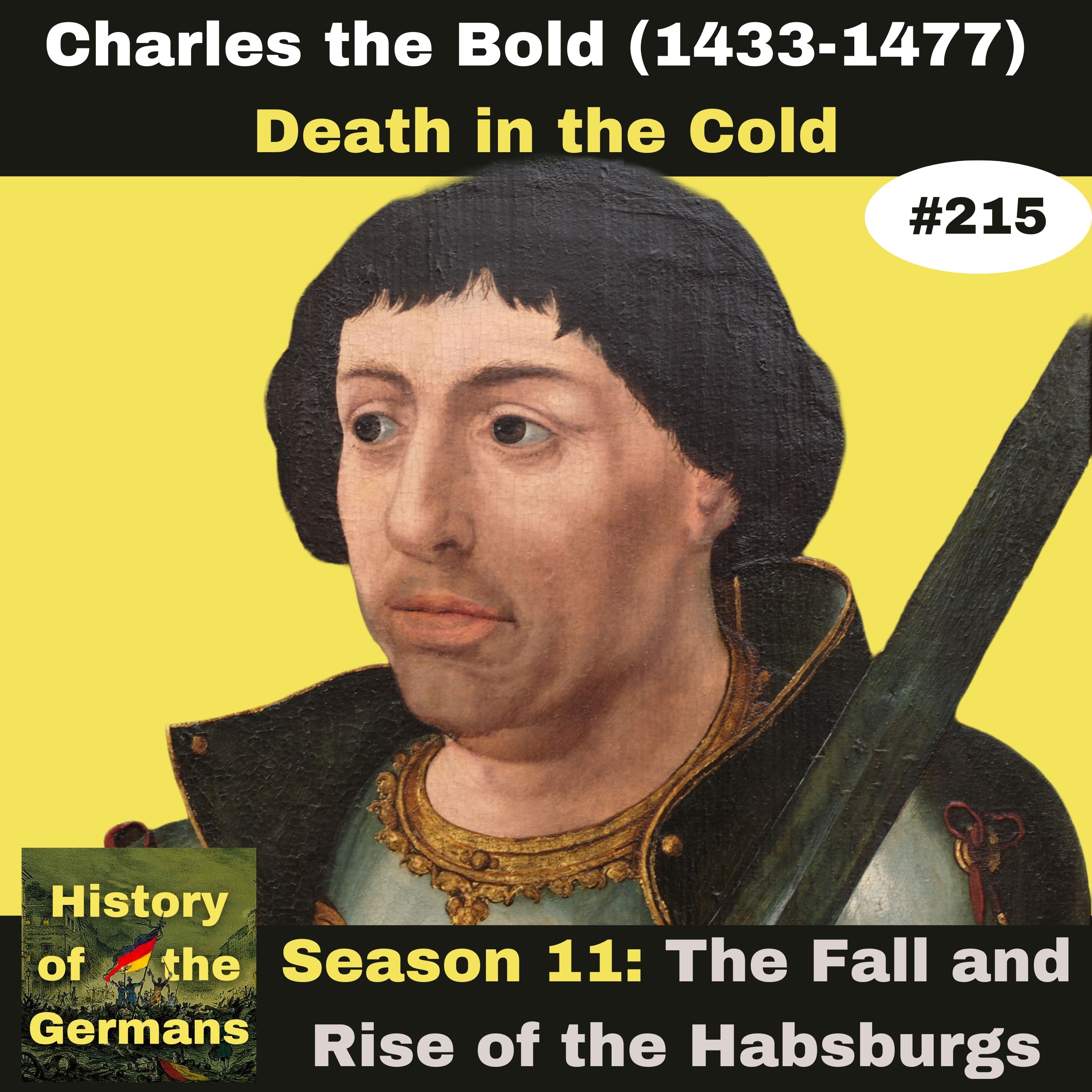
The rise of the Habsburgs to world domination pivots on one crucial moment, the marriage of Maximilian of Habsburg to Mary of Burgundy, the daughter of Charles the Bold, last of the Grand Dukes of the West. The usual story is that young Maximilian one day walked down the aisle of some splendid cathedral and was handed the richest principality in Europe on an jewel-encrusted golden platter by the father of the bride. All he then had to do was lie down and think of the Habsburg-Burgundian empire. That is not quite what happened. When...

Transcript

Automatically generated from the audio. May contain errors.

Hello and welcome to the history of the Germans, episode 215 The Bold and the Cold, The End of Charles of Burgundy. The rise of the Habsburgs to world domination pivots on one crucial moment. The marriage of Maximilian of Habsburg to Mary of Burgundy, the daughter of Charles

of Bold, the last of the Grand Dukes of the West. The usual story is that young Maximilian one day walked down the aisle of some splendid cathedral and was handed the richest principality in Europe on a jewel-encrusted golden platter by the father of the bride.

All he then had to do was lie down and think of the Habsburg-Bergunian Empire. That is not quite what happened. When Maximilian arrived in Ghent in August 1477, his father-in-law laid dead in a a ditch in Lorraine, and large sways of ducal authority and income had gone.

Within less than three years, 1474 to 1477, Charles the Bold had frittered away the mythical wealth of the Burgundian dukes. And not just that. These years between 1474 and 1477 helped turn the medieval empire into the Holy Roman

Empire of the German nation. So please allow me to do this episode even though very very few of the protagonists or parties to the conflicts are Germans in the modern sense. If however you prefer to listen to more Germanic content I have something quite juicy for you.

At midnight yesterday the History of Venice podcast had released a unique three way collaboration where they talked to Mike Coradi from A History of Italy and yours truly about Frederick Barberossa's grand plan to take over northern Italy between 1152 and 1177. I had so much fun doing that and I hope you enjoy listening to it.

As long as you come back. In particular you have to come back for the Christmas special. It is now time to reveal the outcome of your vote. Drum roll!

have voted with absolute overwhelming majority 75% and a little bit more to make me sing. No, no, no, no, no, no, no, no, no. I am so grateful you have saved me from this humiliation. No, the winner is to give you some recommendations for five to ten places in Germany.

I think you should see and there are not on the usual travel itinerary. you so much to all of you who have participated. It was brilliant to see there is now almost a real community of fans of the History of the Germans podcast out there. And I hope I can come up with something interesting. Release date will be Thursday 25th of December.

It's a Christmas special after all. And with that, back to the show. Last week we ended with the lifting of the Siege of Noise. Charles the Bald, Hugo burgundy, the richest prince in Europe and master one of the first modern armies had failed to break a small town on the Rhine. For ten months the finest artillery pieces

the world had ever seen pounded the walls of noise and with every week the city held out the aura of the Burgundian war machine diminished. And as news of the heroic defence spread rapidly across the empire, the mood changed. When I first published last week's episode I said there were no pamphlets telling the story of the Siege of Noise, but I found myself

mistaken very quickly. Printers in Strasbourg and Cologne published rhyme chronicles of the Burgundian Wars in 1476 and 1477, which makes it almost certain that printed narratives had been circulating whilst the fighting was still going on. And we find letters describing the events of 1474 and 1475 in the archives of dozens of

cities taken along by traders going up and down the Rhine and then copied across the extensive networks of the Hanseatek League, Njogsburg Bankers, the Ravensberger Handelsgesellschaft, discussed at the Frankfurt and Leipzig fairs and passed along by messengers in the pay of territorial princes.

From Lübeck to Graz, from Bern to Riga, people heard about the epic struggle in the West. These walls of the second half of the 15th century were the first conflicts that were covered by an early version of mass media. And like mass media throughout the rest of history, news changed minds and attitudes even of people far away from these events.

For most of the period we have covered in this podcast, the Empire had been a matter for the aristocratic elites. It was all about the emperors, the prince-electors, sometimes about the imperial princes. If people outside that demographic had any influence, they'd usually be in churchmen,

whose theological ideas had seeped into the world of politics or who had risen to become bishops, cardinals, even popes. What we have not seen before were educated laymen having a role in politics beyond the confines of their cities or courts.

We already mentioned Martin Meyer, the prime minister of Bavaria-Lanzut and major political opponent of Emperor Friedrich III. He did of course stand out, but men of his background and education permeated the political and economic structure of the territorial principalities leading to the emergence of something akin to public opinion.

And this public opinion is what both motivated Friedrich III to take the lead and the resistance, as well as made it possible for him to gather an army to face off against Charles the bold. His role in the events around the Siege of Noises often played down.

It just does not fit with the idea that Friedrich III was that imperial arch-sleepy-head that Reichs-Erzschlafmütze, who hid in his castle in Styria, never showing up when he was needed. But this time Friedrich III really was everywhere.

He was calling imperial diets, he was attending informal meetings with the local dukes and counts, he was stiffening the resolve of the townsfolk and the estates by by spending Christmas 1473 and 1474 in Cologne, and he was leading an Imperial army to Noysse in 1475.

In March 1475 he wrote the following letter to his subjects, quote, Honourable and well-beloved faithful people, we have, after our great period of instability some time ago, be taken ourselves he there, to the sea of Cologne in person, together with our and the Empire's electors, princes, counts, those of the cities and other faithful

This is the opening of the episode. Open the player for the full interactive transcript with clickable words, translation and flashcards.

Open full transcript

Audio belongs to its publisher and is played from their feed. Rights holders can request removal — copyright & takedown policy

Episodes · History of the Germans