Ep. 212:  Matthias Corvinus (1443-1490) – The Library of the Raven King

Ep. 212: Matthias Corvinus (1443-1490) – The Library of the Raven King

History of the Germans

C1October 30, 202540 min
Play

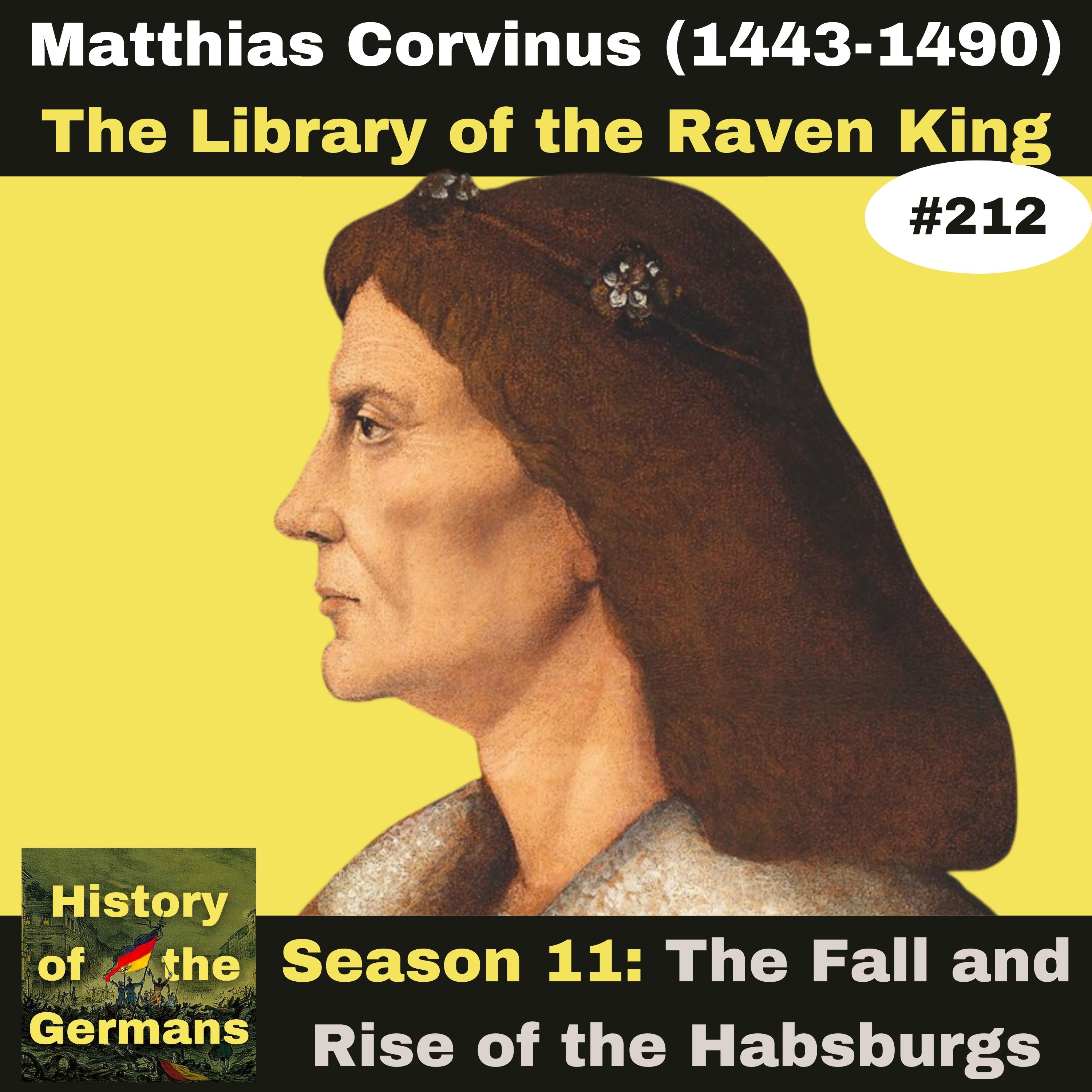
Today we will talk a lot about Matthias Corvinus, the legendary renaissance king of Hungary whose library outshone that of the Medici in Florence and whose standing army was one of the greatest – and most expensive - military forces in 15th century Europe. Why are we talking about a Hungarian ruler in a series about the Habsburgs? Trust me, there is a good reason beyond it being a fascinating life story. The music for the show is Flute Sonata in E-flat major, H.545 by Carl Phillip Emmanuel Bach (or some claim it as BWV 1031 Johann Se...

Transcript

Automatically generated from the audio. May contain errors.

Hello and welcome to the history of the Germans, Abs. 212, the Library of the Raven King, which is also Abs. 10 of Season 11, the Fall and Rise of the House of Habsburg. Now today we'll talk a lot about a man called Matthias Corvinus, the legendary Renaissance King of Hungary, whose library outshone that of the Medici in Florence and whose

The outstanding army was one of the greatest and the most expensive military forces in 15th century Europe. So why are we talking about a Hungarian ruler and a serious about the Habsburgs? Well trust me, there's a good reason beyond it being a fascinating life story.

But before we start, it's just me again in my saffron robes holding out my begging bowl. Now I cannot offer the dharma, the teachings of the Buddha, nor can I explain the principles that help you live a fulfilling life.

All I can offer is the absence of evermore hyperbolic praise for humdrum consumer products, let alone the promotion of sports betting sites which I've just heard is now the number two podcast advertising group. If that is enough for you and you want to drop your grains of rice into my bowl, you

can do that at historyofthedermans.com. And there you can join the immensely generous Clement M., Michael N., Sophia G., Tobias P., Ben H., Paul James V., and Scott P. And with that, back to the show. Last week we ended on a cliffhanger.

Emperor Friedrich III and his young family were huddling together in the cellars of the Hofburg as Canon pounded the ancient fortress. and towers were crumbling and just one errant projectile, one falling piece of masonry or the simple lack of food could have wiped out the dynasty then was destined to rule half

of Europe. How did they get out? Was it the citizens of Vienna realizing that they had gone to Fah or the Empress' brother, the Archduke Albrecht VI, finally put family ahead of personal ambition?

No. came from one of the least probable corners, from Georg of Portibrad, the king of Bohemia. Now Georg you may remember had put his name forward as king of the Romans in an attempt to fill the vacuum the 15 year absence of the emperor from the Reich had created.

And in this attempt to rise to the title, Georg had allied with Friedrich's arch enemies, the Wittelsbachs, namely Ludwig the rich of Bayern-Lanzhut and Friedrich the victorious Count Palatine on the Rhine and who would believe it also with the Emperor's brother and now besieger.

Still, in December 1462 Geogor, more precisely his son Victorin, showed up outside Vienna with a force of his dreaded Bohemian fighters and demanded that Friedrich and Albrecht make peace. Under the watchful eye of the Bohemians the brothers then signed an agreement.

Berber Albrecht was given control of the whole of the Duchy of Austria, including the city of Vienna for eight years in exchange for a substantial annual payment to Friedrich. And so the Emperor Friedrich III, his wife Eleanor and his son Maximilian, were allowed to leave the smoldering ruins of the Hofburg.

Teeth clenched and full of anger and hatred, they had to walk the gauntlet of the citizens of Vienna, who hissed at them, saying, go back to Graz. Seemingly a place so barbarous, no upstanding Viennese felt was fit for human habitation. Friedrich immediately swore revenge and the war of the brothers continued for another

twelve months. In these twelve months Friedrich made some progress. As usual not through action, but through the actions of his enemies. Albrecht VI managed to irritate the Viennese in record time, so that the mayor Wolfgang

Holzer opened secret negotiations inviting Friedrich III to return. Albrecht got wind of that and had Holzer and two of his colleagues tone limb from limb. A move that was not universally popular in the capital, but before the Viennese could gather their spikes in pitchforks to take revenge on their ungraceful lord, Albrecht

VI was dead, died of an infection, the bubonic plague or poison or whatever. He was dead. By 1464 Friedrich III was back in Vienna. As if nothing had happened.

Well, he did not go back to Vienna obviously since the Hofburg was still in ruins and memories were fresh but metaphorically and politically yes, he was back. But that does not answer the more fundamental question. Why did Georg of Potibrat help Friedrich III?

Why did he not just let the stubborn emperor get buried under the rubble of his superannuated castle. That gets us back to the circumstances that had brought Georg of Podjibrat to the throne of Bohemia. Georg as we have heard had not an ounce of royal blood in his veins. He had been elevated

to the title because he had exercised de facto control of Bohemia for more than a decade already. When the nominal king of Bohemia, Ladislav's posthumous died, the states of Bohemia preferred the devil they knew to some hereditary devil they didn't, like Friedrich III or Kazimierz of Poland or the Duke of Saxony.

Podjibrat had managed to walk a thin tightrope between the two main political factions, the moderate Hussites known as the Uttrakwists and the old school Catholics. The Uttrakwists had emerged from the heretical Hussite movement that had taken control of the kingdom in 1420 and that no Catholic army could overthrow.

In 1436 the Council of Marshal had agreed the Compacta with the Hussites an agreement that readmitted them into the Church and allowed them certain Hussite practices, such as the Eucharist in the form of bread and wine, hence the name Eutrochrists, which translates as under both kinds.

We've done a whole series on the Hussites if you're interested. Agheo had been the leader of the Uttarakists, but through a sequence of military successes and subsequent compromises had gained acceptance amongst the Catholics in Bohemia as well. By 1462 when Podjebrat appeared before Vienna, this political construct had nevertheless

come under ever increasing pressure. Not from the Emperor or any of the other frustrated candidates for the throne, or from within, but from the Papacy.

This is the opening of the episode. Open the player for the full interactive transcript with clickable words, translation and flashcards.

Open full transcript

Audio belongs to its publisher and is played from their feed. Rights holders can request removal — copyright & takedown policy

Episodes · History of the Germans