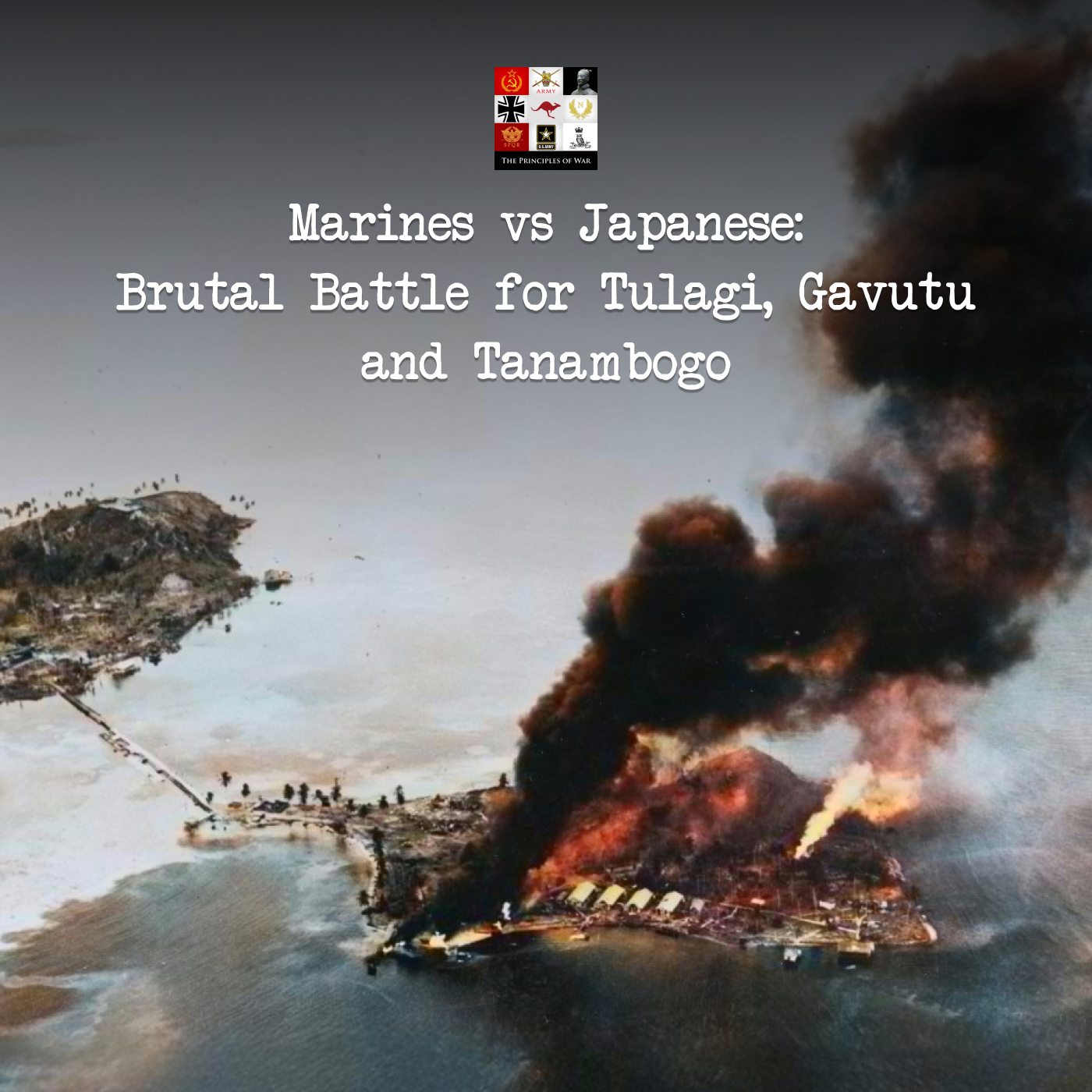
136 - Marines vs Japanese: Brutal Battles for Tulagi, Gavutu and Tanambogo

136 - Marines vs Japanese: Brutal Battles for Tulagi, Gavutu and Tanambogo

The Principles of War - Lessons from Military History on Strategy, Tactics, Doctrine and Leadership.

B2September 15, 202550 min
Play

This is the second episode of our Guadalcanal series with historian and author Dave Holland. Shoestring invasion planning Koro rehearsals fiasco Risking the aircraft carriers vs time to unload the convoy Crutchley's covering cruisers Rupertus leads Tulagi Blue Beach landing Fighting at "the Cut" Improvised cave tactics Gavutu–Tanambogo battles Tanks combat Dave is an ex-Marine and was posted to Guadalcananal with the Australian Federal Police. He regularly leads battlefield study tours through the area. He is a world-leading expert on the battles of Guadalcanal and aut...

Transcript

Automatically generated from the audio. May contain errors.

How did the United States commence their first land offensive, latoral maneuver no less, in the Second World War? We look at US Marines on Tel Aviv 1942, the forgotten first US offensive of the Second World War.

This is The Principles of War podcast, professional military education for junior officers and senior NCOs. Ladies and gentlemen, welcome back to the podcast. Very excited to have Dave Holland back with us today. We are continuing our Guadalcanal campaign series. Dave is a battlefield guide

with extensive experience around Guadalcanal. He's got encyclopedic knowledge of the Guadalcanal land campaign and he is the author of Guaidu Canal's longest fight. Today we're talking about Tulargi, Tanimbogo and Gavutu Islands. Let's get back to the discussion, the marines first combat landing of the Second World War. Welcome back to the podcast, Dave. Oh, thanks, James. It's great

to be back and I'm ready for episode two. So now we're actually getting into some fighting. So absolutely. So we're going to look at Toulagi. The Marines left Wellington on the 22nd of July, 1942. That's the same day as the Japanese landing at Booner and Gona. The task force was to conduct landings on five islands, Florida, Gavuto, Tanabogo, Toulagi and Guadalcanal. How well

prepared were they when they left Wellington? Okay, I think it goes back to the last episode rounds to talk about the composition and the training and the experience or non-experience of the division. I think I said in the last episode they're fairly green. In fact, I'll say 70% to 80% of the division was very green. And so their

planning was three to four weeks or I think extended out to at least the seventh from the first. They got a reprieve for another week, King gave them another week for the seventh. So the plan was only five weeks. So Operation much time became operation shoestring, which was the joke at the time.

It was a shoestring invasion. So I guess, as you could say in five weeks, launching the largest, uh, US amphibious salt in their history at that stage, it's probably the best they could be within five weeks training and five week preparation.

So that was not well prepared, but they had to do what they had to do. And to make the best of a bad situation. Luckily, I think I spoke about in the last episode, they had some good quality officers and some good NCOs and they had a high quality of the green recruits.

I think I said too also that of these recruits one also said they're all officers. If they were in peacetime they'd be officer caliber because of volunteers and these are the bunch that came straight out of the harbors. They're very well motivated. They were keen to take on the Japanese and they're very motivated and dedicated sort of speed ready to go.

Now on the way to Guadalcanal, they stopped at Coro Island in Fiji for two rehearsal landings. How did they go? Well, I think it's kind of common knowledge that it was a fiasco, a complete fiasco. That was what Lieutenant Colonel Emerald Triney, the division clan officer said was

a complete fiasco. But in a lot of books and a lot of accounts, they just wrote it off as nothing was learned. But there was some valuable lessons learned from this.

I guess some of the things that they dubbed it to be a complete fiasco, the reasons were, law the boats were hung up on the coral. So car road is about 400 miles south of Fiji.

That was the rendezvous place. And there was also the rendezvous for, or the meeting place for the whole fleet. So he had Admiral Fletcher,

he had Admiral Kerner and the transport units. He had them all meeting at one stage. This is the first time that the, the three elements were meeting all together.

So it was also a chance to do the horse. also a chance to have the actual first conference with the tactical commander which is Admiral Fletcher at the time. So we all talked about that in a second but when they actually did the dress rehearsals, a lot of the boats were hung up on the coral and they landed like

one or two hundred yards off. They swamped a lot of boats, ran into their own beaches, landed on their own beaches. Some of the guys going down the ladders and the ropes got hung up, equipment fell in the ocean. It was a complete fiasco. The things they, I guess, cons you could say. It was the first time for a lot of the smaller units that have meetings.

So they coordinated a lot of stuff. Some of the air and the naval coordinated the timings with the firing and how they worked together. The bulk timings were worked out. It allowed them a chance to repack and continue packing some of their gear because as you know, we discussed in the last episode, when they landed in New Zealand under operational angle for the six-month deployment

there they're all admin packed in the cargo ships so they had to do a rush repack the best they could to combat load those ships so it gave them a chance to continue that combat loading so there was some lessons learned from it and some good things from it but overall it didn't fill them with optimism now the

conference was on the 26th of July so that was Fletcher he was meeting with Turner who was the amphibious force commander van der griff which is a division the first marine division commander and a guy called Admiral Ruiro Mokalahan. So he was the chief of staff for Ruiro or Vas-Ameral Gormley.

It was a South Pacific commander. Interestingly, Gormley didn't attend. He was still back in this stage. I think he'd moved his headquarters to New Caledonia, I think at that stage. He was potentially New Zagan, but he was one of those two guys I think he had far deployed to New Caledonia. But he wasn't there.

So Fletcher wasn't really convinced about the invasion. He, what Van Der Griff said that Fletcher had the, he was opinion that Fletcher thought of it more of a raid, a febriest raid in and out, not of we're gonna go there and stay. Obviously he had three carriers and he was very protective of his carriers. So the debate was how long

This is the opening of the episode. Open the player for the full interactive transcript with clickable words, translation and flashcards.

Open full transcript

Audio belongs to its publisher and is played from their feed. Rights holders can request removal — copyright & takedown policy

Episodes · The Principles of War - Lessons from Military History on Strategy, Tactics, Doctrine and Leadership.