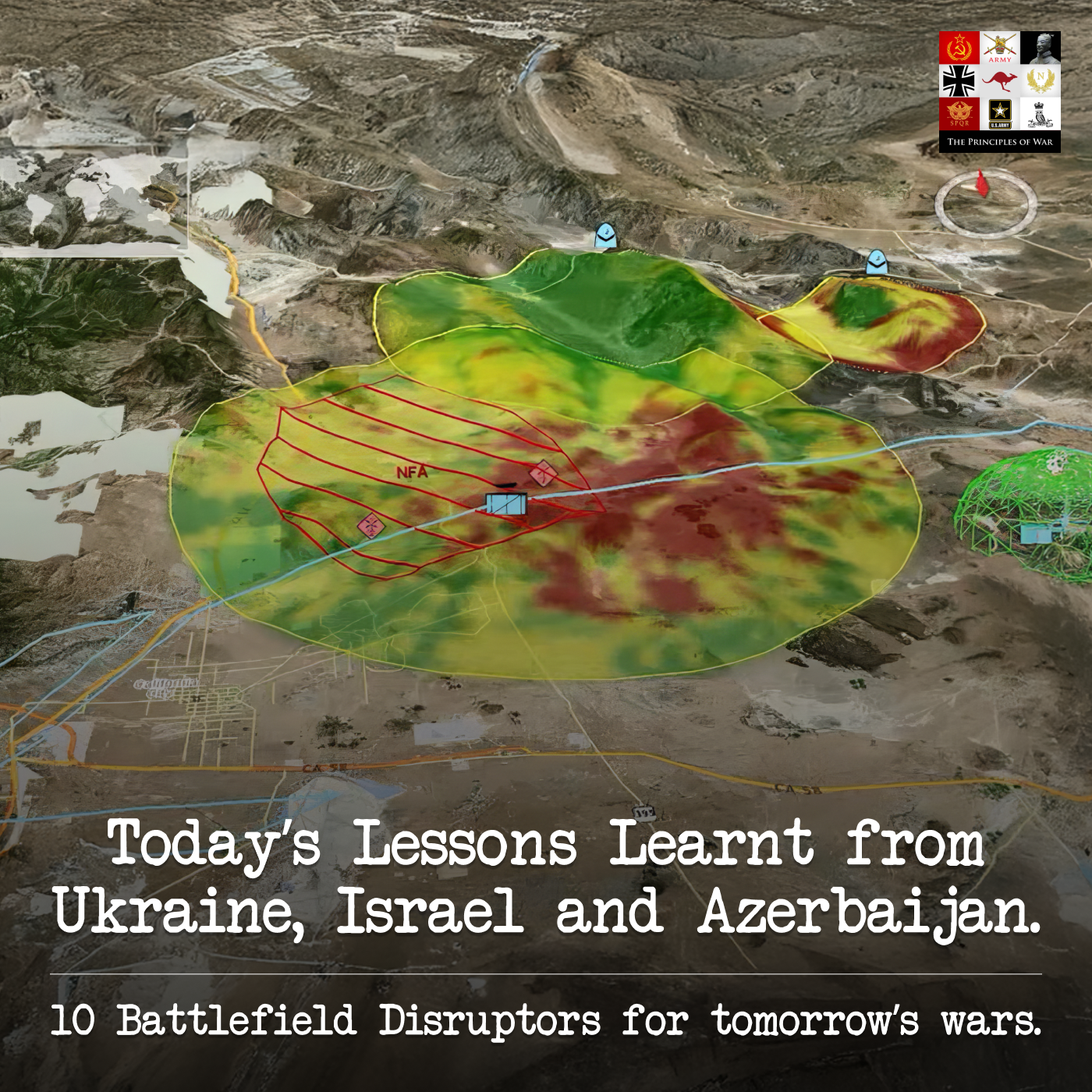
132 - Ten Battlefield Disruptors for Tomorrow's Wars

132 - Ten Battlefield Disruptors for Tomorrow's Wars

The Principles of War - Lessons from Military History on Strategy, Tactics, Doctrine and Leadership.

B2July 13, 202534 min
Play

How is the modern battlefield changing? What role is technology like Artificial Intelligence, drones, precision strike and electronic warfare changing command and control, ISR and combined arms? This is the first of 3 episodes with retired Colonel John Antal, who has studied 2nd Nagorno-Karabakh, recent Israeli battles and the war in Ukraine. Check out the show notes for all of the information that we cover in this episode as well as the images and other details that didn't make it into the podcast.

Transcript

Automatically generated from the audio. May contain errors.

Can we imagine how future battles will be fought today so that we can be ready for tomorrow's combat? We talk to John Antle about the battlefield disruptors that are changing the character of war. This is The Principles of War Podcast, professional military education for junior officers and senior NCOs. Ladies and gentlemen, welcome to Episode 132 of the Principles of War podcast, 10 battlefield

disruptors that are changing the character of war today. I'm very excited to have on the podcast today retired Colonel John Antle. He's the author of a range of books, including Seven Seconds to Die, the Second Nagorno-Karabakh War, and Next War, reimagining how we fight. He spent 30 years in the US military as an armour and cavalry officer. He's a graduate of the US

Military Academy at West Point, an airborne ranger. He's graduated from the US Army Command and General Staff College and the Army War College, and he's commanded combat units from platoon through to regiment. He's conducted intensive studies into some recent conflicts, including 2nd Nagorno-Karabakh, the Israeli conflicts and of course the conflict in Ukraine.

He studied what changes have been occurring on the battlefield, these changes are predominantly technology related. These are nations that are fighting existential wars, there is a very fast pace of innovation and adaption. The challenge for militaries that aren't decisively engaged in combat today is how can they observe the changes that are occurring on the battlefield, adapt the

technology into their own militaries and then develop the tactics, techniques and procedures that are required to be able to wield these weapons on tomorrow's battlefield. We've got a lot of ground to cover, this is going to be the first of a three-part series with John. He's done extensive research, extensive analysis, and he's been very generous with his time in sharing his

findings. So let's get straight into it. So John, welcome to the podcast. Yes, well thank you very much for having me on your show. In your book Next War, you described nine battlefield disruptors. What was the process that you've gone through to classify those disruptors? What I had done is with a long study of military history ever since, you know, I can remember being

conscious, you know, I've been studying military history. So putting all that together, West Point 30 years in the US Army, Commanding General Staff College, you know, War College, all those things, commanding units, being around the world and studying wars. I looked at the wars of the last few years. And I developed from those wars, the second to go to Karabakh War, the 2021

Israeli Hamas war, which is not the war that is happening now, but a war that only lasts at 11 days. The neat thing about that war was the important thing about that war was that was the first war in history primarily won by artificial intelligence. So to know that and to say, oh my gosh, look at that, how come we're not studying it is really important. The second to go to Kiribati, which

happened in 2020, was the first war in history primarily won by robotic systems. So we should We should pay attention to that. It was a 44-day decisive conflict, which ended in a decisive military victory. We really should pay attention to that because how many decisive military conflicts have you

seen lately. The next one was, of course, the Russo-Ukrainian war, which is ongoing, and the most innovative and bloodiest war in history in the 21st century. the ongoing Israeli Hamas, Hezbollah, Iran, Houthi fighting, which just recently has been

curtailed and ended in a ceasefire between Israel and Iran, but the war in Hamas is still going on. So from that, I developed these nine disruptors, and since the book was published, I now have 10. So I'm doing my best not to add any more, but I added one and be happy to go through all of them with you because I think those disruptors, although they are not principles of war, are things

that every military professional, anybody who cares about the military sphere, needs to understand how warfare has changed because the difference between 20th century war and 21st century war are these disruptors plus. So that's important to analyze what's going on as the pace of change is so rapid these days, we have to think and pause and take time to discuss this

with like-minded folks so that we can understand how to move forward. Because the goal of all this, the goal of all this study and the whole point of talking about this is for leaders to gain foresight. And foresight, I define as the ability to solve problems in the short term and

create solutions for the long run. So solve problems in the short term and create solutions for the long run. This is the kind of leader I wanna follow.

It's the kind of leader most people wanna follow. You've gotta have the character, you've gotta have the competence, you've gotta have the commitment.

But if you have that and foresight, you're an extraordinary leader. Being able to, as we say, look two, three moves ahead,

four moves ahead, six moves ahead, imagine. And in an era where AI, artificial intelligence is speeding everything up dramatically. We really need leaders with foresight.

AI can provide information. In some cases, it can provide some correlation of data that gives you some trends and gives you ideas, but it can't provide you foresight.

Foresight is a very human concept. Now, maybe someday AI will give us foresight. In other words, be able to run enough calculations But it says your probability of success is 95% or your probability of failure is 95%.

And that's when you say, don't ever tell me the odds. It's really interesting you mention that because I think a fundamental part of the leadership is having that vision thing. And we need a vision of what the future battlefields are going to look like because

otherwise we're not going to be able to create a training program that's going to be in any way effective. Soldiers are going to be looking for someone who can say you know, this is where we need to be

This is the opening of the episode. Open the player for the full interactive transcript with clickable words, translation and flashcards.

Open full transcript

Audio belongs to its publisher and is played from their feed. Rights holders can request removal — copyright & takedown policy

Episodes · The Principles of War - Lessons from Military History on Strategy, Tactics, Doctrine and Leadership.